Weigh one cup of your own flour. Every dry weight in the pack follows yours.
Published charts put all purpose flour anywhere between 120 and 142 grams a cup. Whole wheat runs 113 to 156.
Nobody who printed those numbers has met your bag, your cup, or the way your hand goes into the flour. So the pack asks you for one measurement, once, and every dry figure follows it from then on.
The rest is paper. Cup weights for 35 ingredients at every fraction a recipe actually asks for, oven temperatures in four scales, twelve tin areas, and the three things in a recipe that do not scale by multiplying.
The Kitchen Pack comes with IngredientCalculator Pro, and it is not sold on its own. See everything Pro does, and try the scaler free.
The one thing in here you will not find elsewhere
Published cup weights disagree with one another, and the disagreement is not sloppiness. A cup measures volume.
Flour packs differently depending on whether it was scooped straight from the bag or spooned in and leveled, and the gap between those two habits is wider than the gap between most published charts.
So the pack asks you to weigh one level cup of your own flour, once, and type the number in. Every figure then adjusts to how you actually measure.
It takes about ninety seconds and it beats any published chart, including the one printed on page 2.
If your flour comes out at 132 grams rather than the 120 in the chart, three quarters of a cup is 99 grams for you, not 90.
That is a nine gram error on one ingredient in one line, repeated through every recipe you have ever baked from cups.
What you are buying
A zip file of about 320 kilobytes. Unzip it, and every file in it opens in the browser you already have.
The zip is the offline half of IngredientCalculator Pro. The other half is a key that opens the paid sections of the Recipe Scaler on this site: recipe costing, a recipe library, batch scaling, print cards and a merged shopping list.
| File | What it does | Size |
|---|---|---|
| Kitchen-Pack-Reference.pdf | Ten pages built for paper. The chart, the oven table, the pan grid, the scaling rules and the sources behind every number. | 762 KB |
| Kitchen-Converter.html | The converter itself, in one file, with the calibration step below. | 14 KB |
| Recipe-Scaler.html | Paste a whole recipe, change the servings, get every line rewritten. Understands 1 1/2 and 3/4. | 8 KB |
| Pan-Size-Converter.html | A different tin from the one the recipe wants. Scales by area, which is the only honest way. | 7 KB |
| Oven-Temperature-Chart.html | Fahrenheit, Celsius, gas mark and fan, plus a converter for any temperature. | 7 KB |
| Printable-Chart.html | One page, 35 ingredients, seven columns. Made to live inside a cupboard door. | 7 KB |
| ingredients.csv | The same numbers for Excel, Numbers or Sheets. | 2 KB |
| ingredients.json | The same numbers again, for anyone who codes. | 6 KB |
| START-HERE.txt | What to do first, and the ninety second calibration. | 3 KB |
What the pages look like
What is inside the printed reference
Ten pages, sized to print without clipping on both A4 and US Letter, with no shrink to fit and no cropped columns.
- Weigh your own cup first, and why the number on the bag is not the number in your bowl.
- Cup weights for 35 ingredients, whole cup and six fractions, 245 figures.
- The same weights per tablespoon and per teaspoon, with implied density so you can check any figure against water at 1.00.
- Oven temperatures across Fahrenheit, the Celsius figure printed on a dial, the exact arithmetic conversion, gas mark and fan.
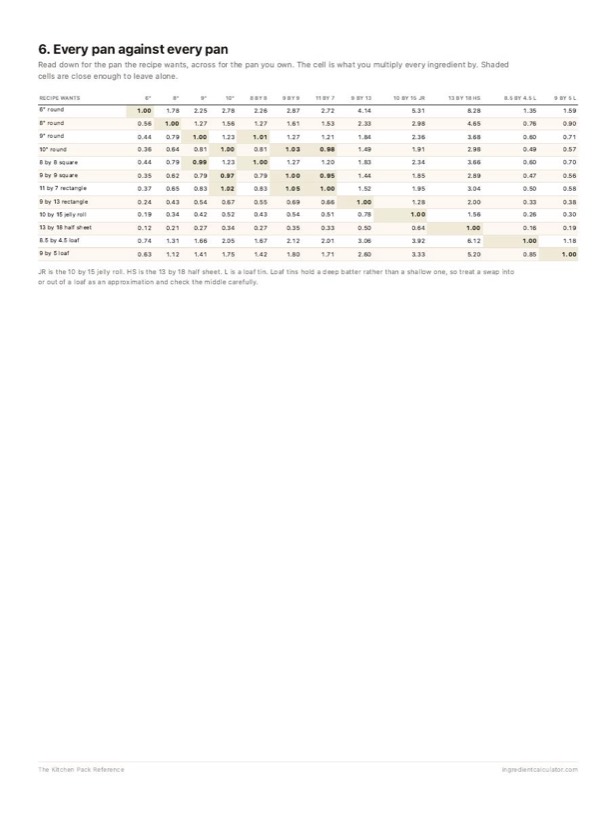
- Pan areas for twelve tins, and why a half sheet is bigger than most people think.
- Every pan against every pan, 144 multipliers in one grid.
- Scaling a recipe, including the leavener, salt and spice corrections that are not multiplication.
- Volume equivalents, and the four different things the word cup means.
- Where every number came from, named, so you can check them.
Why this costs money when the converter does not
The converter on this site is free and it stays free. No paywall goes over the math, now or later.
It answers one number quickly, which is the right answer when you have a phone in your hand and a signal behind it. For a home cook, it is the whole answer.
At $79, Pro is not priced for a home cook, and it is not meant to be. It is priced for people who sell what they bake or cook and need the batch cost, the price per serving and the margin to be right.
The pack is the offline half of that. Paper inside a cupboard door, files on a laptop with the wifi off, 245 figures instead of the one you asked for, and the step the free converter does not have. It throws out the published average and uses your cup.
What a search gives you, and what it leaves out
Two careful bakers, the same bag of flour, twenty grams apart. A search gives you one number from one source. Search again from a different site and the number moves.
| Ingredient | Low | High |
|---|---|---|
| All purpose flour | 120 | 142 |
| Whole wheat | 113 | 156 |
| Baking powder | 192 | 240 |
All purpose flour across King Arthur, the USDA and America's Test Kitchen.
One published chart puts a cup of water four percent off the figure physics gives it, and that one you can check yourself with a jug and a scale.
The pack prints the range beside every figure rather than picking a winner and hiding the argument. Then it asks you for the one measurement that settles it in your kitchen.
No other cups to grams reference found in four rounds of competitor research, last run in August 2026, asks you to do that.
Where the numbers came from
Section 9 of the PDF names the source behind every figure, so you can go and check them. Or disagree.
Grams are rounded half up, the way a kitchen rounds, and one US cup is taken as 236.588 millilitres, which is the cup that recipes written in cups mean.
The scaling corrections are 75 percent for leaveners and thickeners and 70 percent for salt, and both carry their citation on the page.
If a number here contradicts a source you trust, send the source and the figure to the address on your download page. Corrections go into the next version.
Every later version is free to anyone who bought an earlier one.
What lands on your machine, and what stops you copying it
Nine files, about 320 kilobytes, zipped. Five of them are single HTML files.
You open one by double clicking it, and it makes no network requests of any kind. That was checked with the machine forced offline, and 30 of 30 functional checks passed on the same run.
Nothing installs, nothing calls home, and no service can be retired out from under it. The PDF page box is 210 by 279 millimetres, so it prints without clipping on A4 and on US Letter both.
On a phone, open the converter in the browser and add it to the home screen, and it keeps working in aeroplane mode.
Nothing stops you copying the zip either. There is no lock on it, and the key that opens Pro on this site is not tied to your name or an email address. The honest version of that sentence is that a determined person could pass the files around.
What $79 buys is the work, the corrections, the key to the paid sections of the scaler, and every later version of both the pack and the web tool at no extra cost. The files are yours to keep and print, and not yours to resell. That is the whole licence.
Who should skip this
If you cook at home and convert a cup to grams once a week, skip it. Use the free converter. Same data, no charge, and that will not change. At $79, Pro is not built for that kitchen.
If you own a kitchen scale and you cook from recipes written in grams, skip it too. Weighing directly beats converting every time, and page 1 of the PDF says so in its first paragraph.
If you do not own one, buy the scale before you buy this. A scale removes the conversion instead of correcting it.
Pro earns its money in the narrower case.
You sell what you bake or cook, and you need to know what a batch costs, what to charge for it, and how much to buy for an order of fifty.
The pack is the offline half of that. The scale is in a drawer you cannot reach, the phone is across the room, your hands are covered in dough, and the recipe was written in cups by somebody whose cup is not yours.
If none of that is your kitchen, keep the free converter and my thanks.
What happens after you pay
Stripe takes the card and sends you straight to a download page. The zip is there, along with the key that opens IngredientCalculator Pro in this browser: recipe costing, the recipe library, batch scaling, print cards and the shopping list.
Save the zip somewhere you will find it again, because the files are yours from that point on and they do not need this site to keep working.